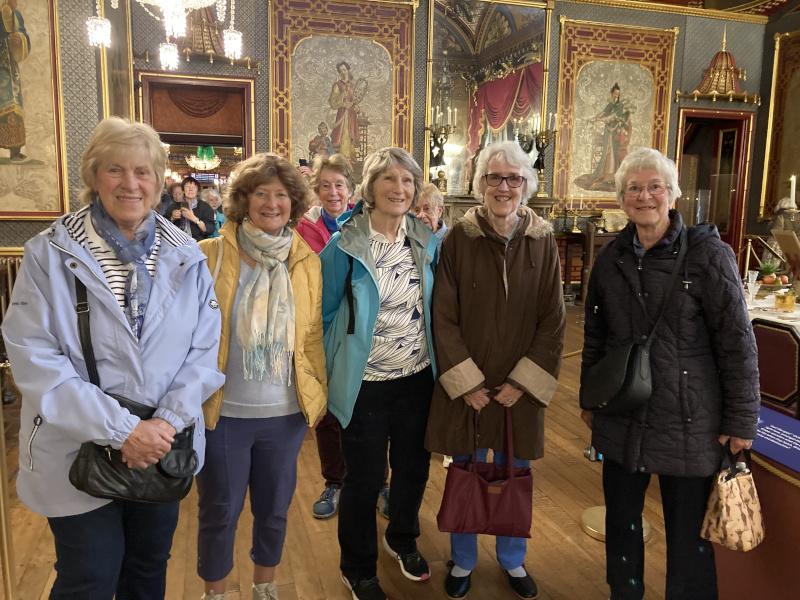
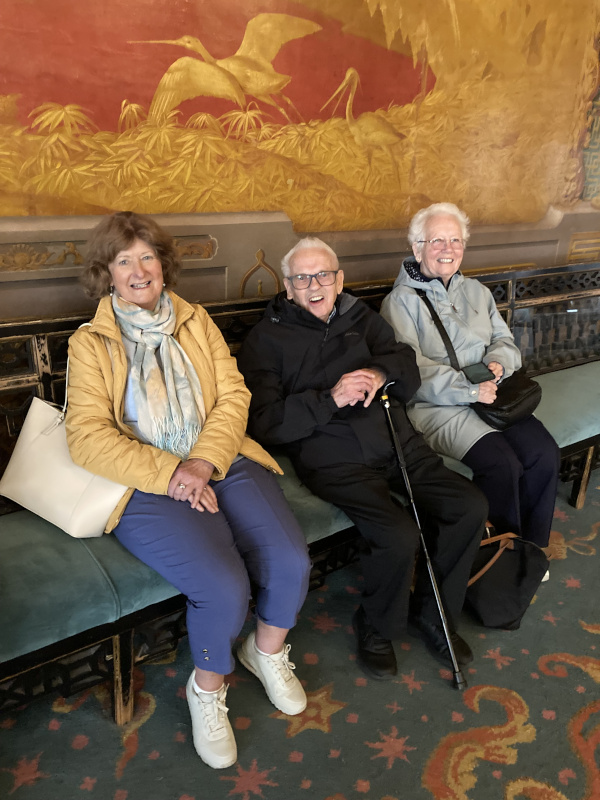
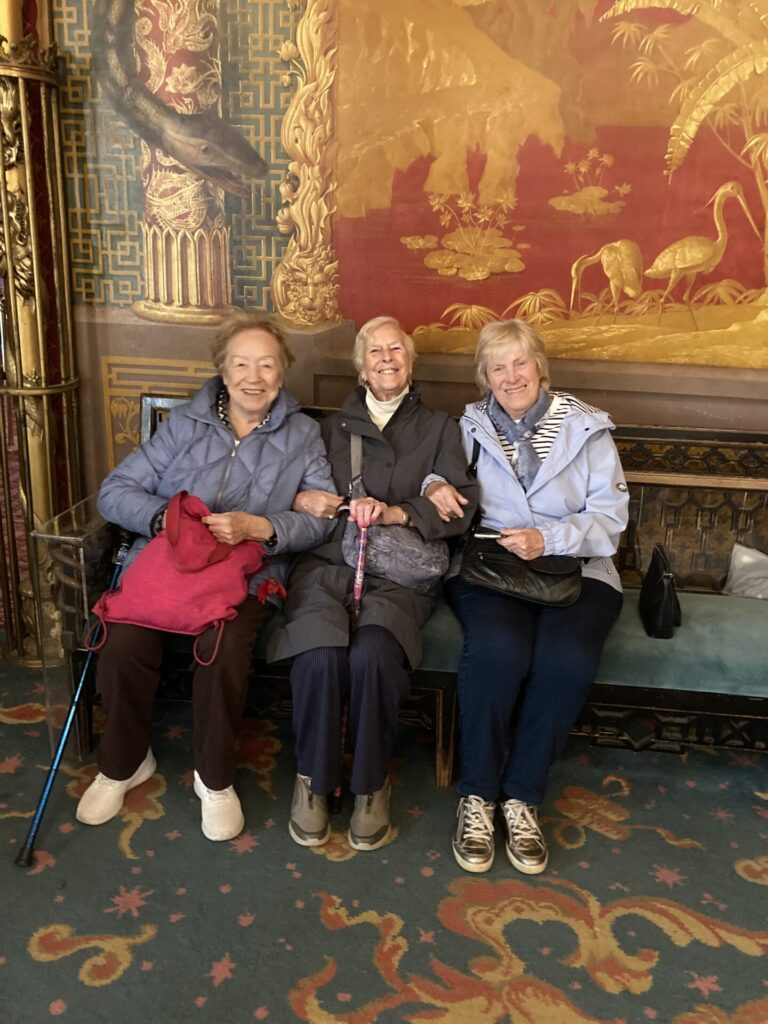
On a blustery sunny day with the weather forecast predicting heavy rain showers, we boarded the coach, (with our regular coach driver Gideon) to Brighton. The trip was to wander round the Royal Pavilion, unguided, to then have free time to explore Brighton. Even Joan Young (who organised the trip) said that when she booked the day, the weather that she had envisaged was a warm summers day by the seaside!
However, the weather turned out quite good. It was sunny, warm out of the wind, and only one short shower. The ‘weather gods’ were on our side.
As we approached Brighton, Gideon took the scenic route over the downs, with Brighton and the sea glistening in the distance. Very Picturesque.
He parked along Church Street, next to Brighton Dome, Museum and Art Gallery. From there it was only a short walk through the lovely Pavilion Gardens to the Royal Pavilion building. The gardens were a good place to have a picnic lunch, the flowers in bloom, sheltered from the wind, and with a café and toilets in the grounds.
Brighton Pavilion was constructed for George 1V when he was Prince of Wales. It was originally a simple farm house, that George, Prince of Wales, rented when he first visited Brighton in 1783. As he enjoyed the informal atmosphere of the town he asked, in 1787, Henry Holland to create a neo-classical villa, known as Marine Pavilion, on the site. From 1802 the interiors were decorated in the Chinese style. When in 1811 George became Prince Regent, he employed John Nash to enlarge the building. Between 1815 and 1822 it was transformed into the present Pavilion, with the exterior inspired by Indian architecture.
His brother William 1V, shared George’s fondness for Brighton. However, Queen Victoria did not, and sold the palace to the town of Brighton in 1850, having removed all its fittings and furniture. Since then, much of the original furniture and decorations have been returned and restored. A £10 million structure and interior restoration programme was completed in the 1990s, and restoration is still on going.
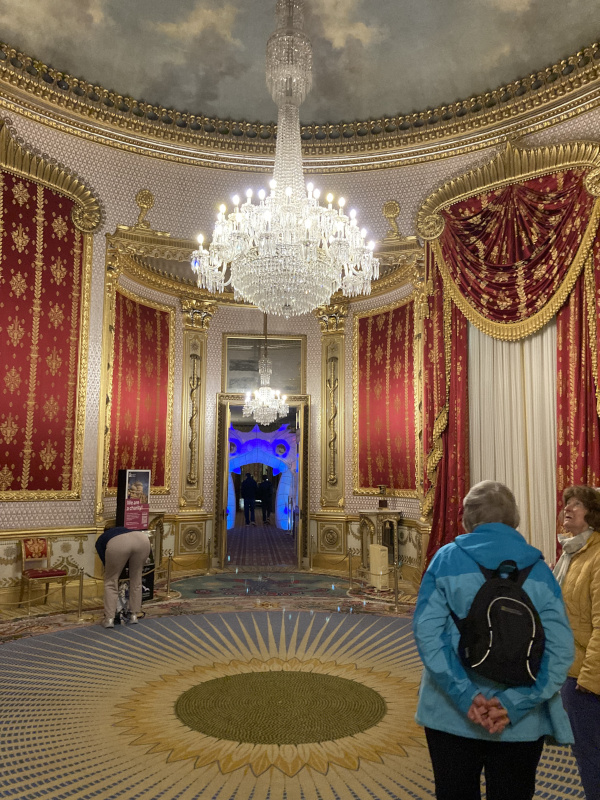
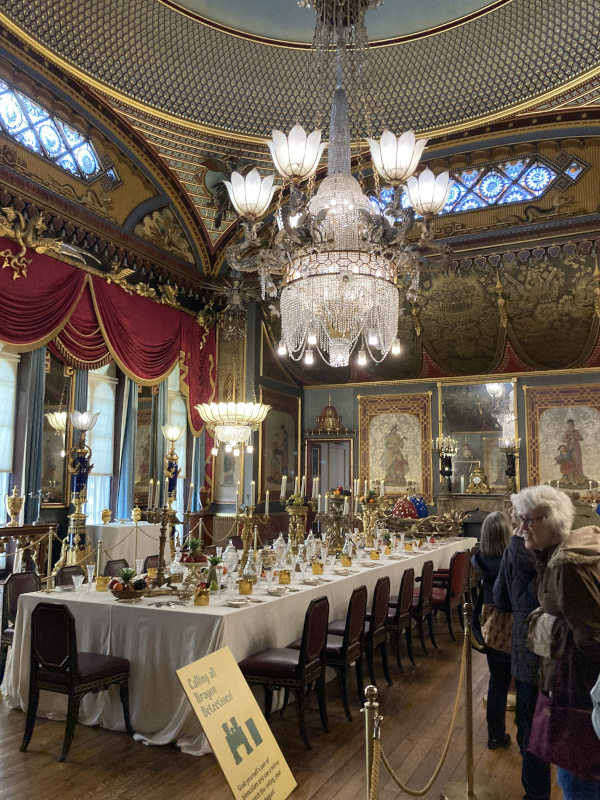
As you walk around the ground floor of the Royal Pavilion, the opulence is astounding. Initially the Octagonal and Entrance Halls are muted in their Chinese decoration. But entering the Banqueting Room the full dramatic Chinese imagination is realised with bold decoration that was created by artist-designer Robert Jones.
The Magnificent central chandelier is about 9 metres in height and weighs 1 ton. It is held in the claws of a silvered dragon suspended from the apex of the ceiling. The 8 Pedestal Lamps. Designed for the room in 1820, are made of blue Spode china flanked by dragons with gilt brass mounts.
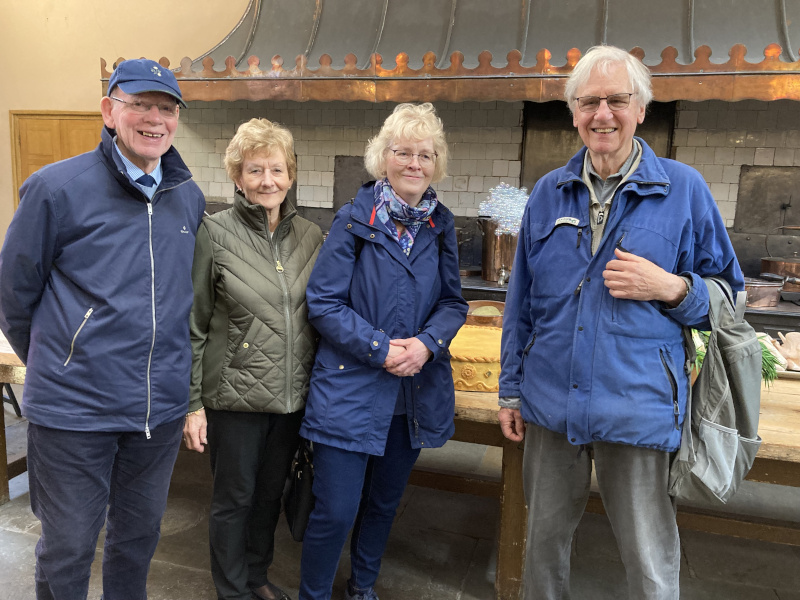
The Great Kitchen was modern for its time, with a high ceiling and decorative copper canopies to draw heat, smells and steam away. Elaborate banquets were prepared here, some featuring menus of up to 60 dishes! There is an amazing display of copper utensils, formally part of the kitchens at Apsley House, London, and is similar to that used in the Pavilion during the Regency era.
As you continue through the State Rooms the opulence continues. The Music Room reflects George 1V passion for music. The spectacular decoration was created by Frederick Crace. The rich red and gold wall paintings depicting dragons, were returned by the Crown in the 1860s.
Upstairs are the bedrooms used by George 1V’s brothers, and in the early 1990’s Robert Jones original decoration schemes were recreated featuring yellow dragon wallpaper and Chinese export oil paintings.
There are also the apartments used by Queen Victoria between 1837 and 1845, where the vibrant wallpaper is a reproduction of the original hand-painted Chinese paper.
Two exhibition displays are shown in the upstairs rooms. The first is about the history of the restoration of the Royal Pavilion. The second is about the repurposing of the Pavilion as a Military Hospital during the First World War, specifically treating Indian soldiers.
It was definitely a treat to view the lavish Chinese decorations, especially all the dragons that are featured in the fabrics and furnishings. There were even glimpses of extra dragons hiding for younger visitors to find!
The Royal Pavilion is conveniently positioned for people to chose different eating and drinking places. To explore old parts of Brighton by visiting ‘The Lanes’ (mainly jewellery shops than antiques). To go up to the ’North Lanes’ for a 1970’s hippy vibe, or to go down to the sea front for some bracing sea air.
All in all, a very enjoyable day. Thank you, Joan Young for organising the trip, and thank you to Gideon for an uneventful drive back to Tunbridge Wells.
Katharine Hammerton-Fraser